Text: Alexander Andrusenko (Team Lowrance Estonia)
This year Lowrance released a new device Lowrance HDS PRO, which replaces the previous generation’s top model, HDS Live. Many users of HDS Live or even lower-tier devices are now faced with a choice: is it worth buying the new one, and what makes it better?
Let’s start right away with the most important update – the new device introduces a new transducer, the ActiveImaging HD 3-in-1. The previous transducer was simply the ActiveImaging 3-in-1, and now it has gained two letters: “HD”. What does that mean? The new transducer adds a higher frequency that everyone had been eagerly waiting for, namely 1 MHz (to be exact, 1075 kHz) on Side Imaging. Why is that good? In simple terms, the higher the frequency of the signals sent by the transducer, the more detailed the image on the device screen. At a higher frequency, you can see small details better than at a lower frequency, the image is sharper, and fish and structure are easier to see.
The other side of the coin is that at a higher frequency the viewing range is smaller, because the signal attenuates faster. This is not just a technological limitation, but a matter of physics. So in theory, side imaging at 1075 kHz (compared to 800 kHz) should be more detailed and sharper, but with a smaller viewing range. By the way, the higher frequency is also available on DownScan, namely 1200 kHz, which is a significant improvement compared with the previous 800 kHz.
I got the new model in June 2023 and have since had the chance to test it for some time in different conditions, including domestic competitions in Estonia and the World Championships in Latvia. So I’ll share my impressions and the differences compared with HDS Live and the previous transducer. It’s quite difficult to test two transducers side by side, because the signals from the two transducers interfere with each other, and when both are running there is a lot of interference on both screens, so first you have to look at an object with one transducer, then stop that transducer and switch on the other. I can say that the image at 1075 kHz at shallower depths in side view (at least up to 7 m) is really sharper than with the old transducer at 800 kHz. At greater depths, however, the laws of physics come into play, and at the higher frequency the viewing range is noticeably smaller and the image becomes blurrier.
In practice, this means that if you are driving in water up to 10 m deep, then 1075 kHz is better than 800 kHz with the older transducer. When you get into deeper water, you need to switch the transducer to 455 kHz, then you can see the bottom relief and fish better. There is no intermediate frequency on the new transducer; there is only 455 or 1075 kHz. But I can say that even at 455 kHz the image is very nice; I would compare it to a 3D transducer through a 3D module. Personally, I use 455 kHz in depths over 10 m and when I want to look wider than 20–30 metres. For example, on Lake Peipus when looking for a perch school or stone crows, it is sometimes sensible to switch to 455 kHz, then you can see wider, although the image detail is slightly lower than on 1075, but larger objects or schools can be seen very well.
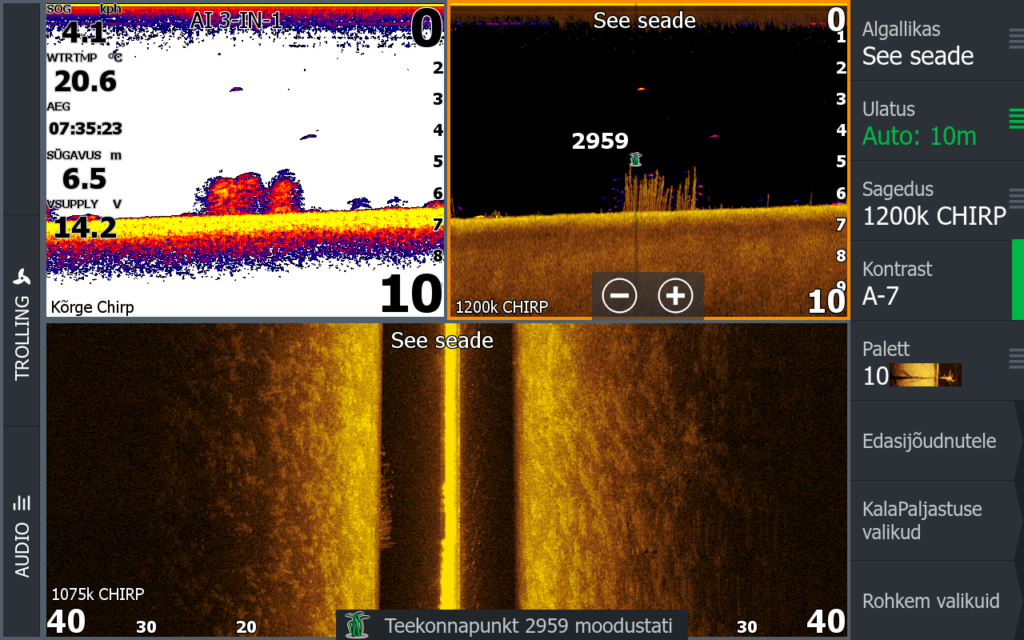
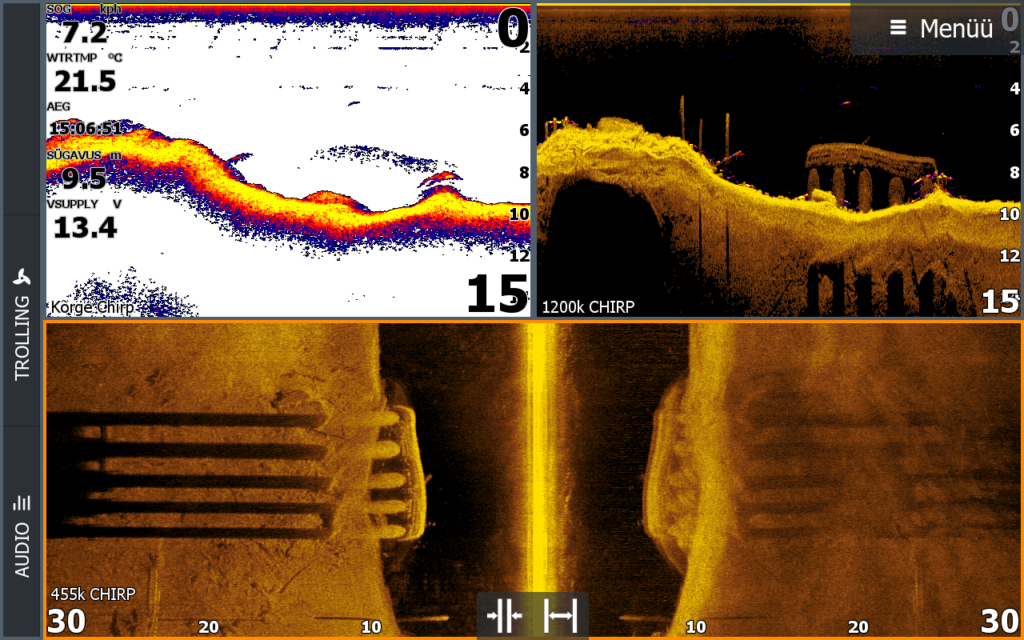
DownScan is especially impressive (view under the boat). If you compare it with the image from a normal sonar (200 kHz or high CHIRP 2D), the difference is enormous. When the sonar only shows some blobs (see screenshot), from which you cannot tell whether it is a rock, fish or weeds, DownScan at 1200 kHz shows very clearly that it is algae, and even each individual stalk is very clearly visible. I have driven a lot on one lake and at certain depths I saw some algae, but with 800 kHz DownScan it was not possible to tell exactly what kind of algae it was. Now I checked those places again with the new HDS PRO and indeed every stalk and tuft of grass is very clearly visible. I would say the difference in DownScan compared with the previous transducer is very noticeable.
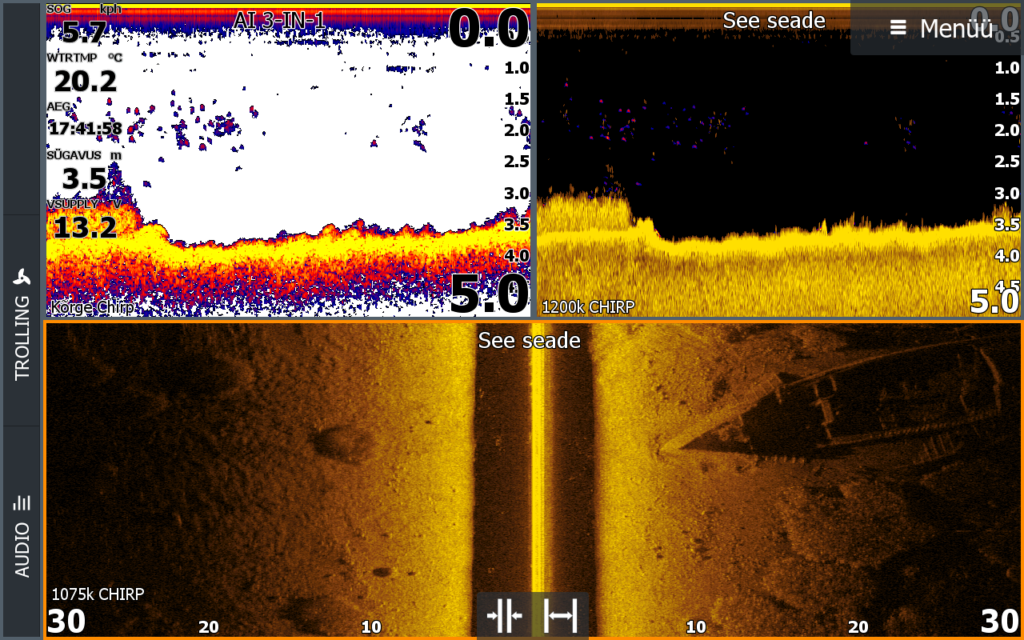
The new transducer also shows better in very shallow water. In the screenshot, for example, there is a large sunken boat at a depth of 3 metres, which is visible in great detail. In a bay at sea I even managed to see a pike from the boat at a depth of 1 metre. With the old transducer it was never possible to see fish in such shallow water in side view.
By the way, the new Lowrance HDS PRO is also faster than the previous version. I have over 3000 waypoints in the plotter, and when the number of points gets that high, HDS LIVE became a bit slower, but HDS PRO is very fast and responds to button presses instantly. Another new feature is the ability to overlay the Active Target transducer’s Scout Mode or the 360 transducer onto the map. This means that if you are fishing, for example, on a large lake at a specific spot with either Active Target or a 360 transducer (mounted to the Lowrance Ghost bow motor), it is possible to save that image as a new layer on the map. And if later you browse the map at home, for example, you can see exactly what you were fishing there, i.e. what image the Active Target or 360 view showed.
So, in the end, is it worth replacing HDS LIVE with the new HDS PRO? Everyone decides for themselves, but in my opinion the new transducer is still significantly better than the old one. What you need to keep in mind is that the new transducer also works with the older HDS LIVE model, but the old unit does not allow you to enable the 1 MHz frequency; you can only use 455 or 800 kHz like with the old transducer. So if you want to use the new transducer at 1 MHz frequencies, you will still need to buy the new device.
Sunken boat in side view at 1075 kHz:
Algae clearly visible in DownScan view at 1200 kHz:
Rocky bottom and schools of small fish. Each fish is very well distinguished both in DownScan and in side view.
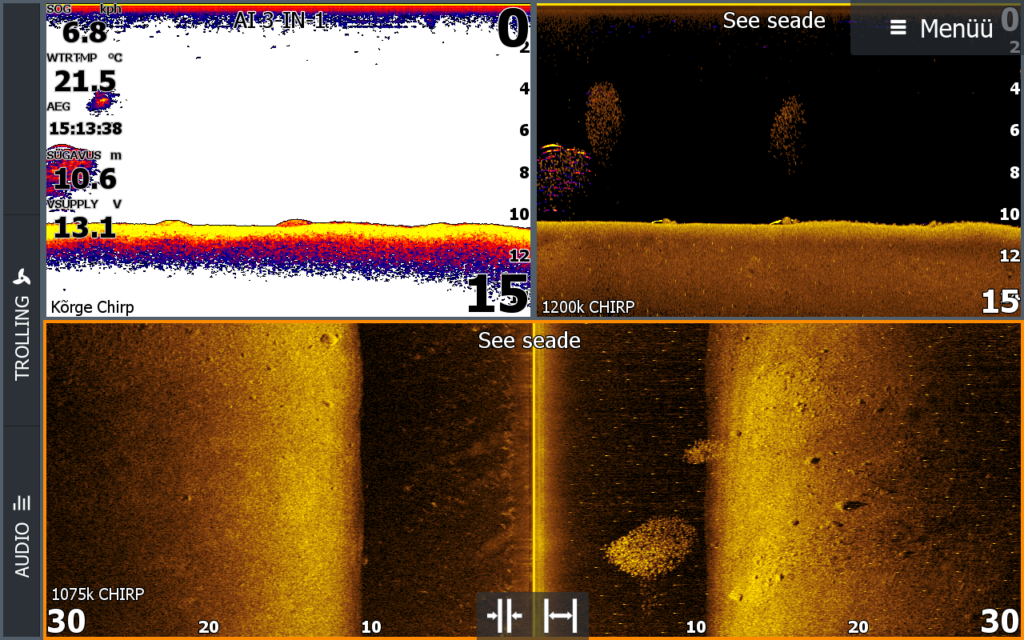
Some structure on the bottom is visible in great detail:
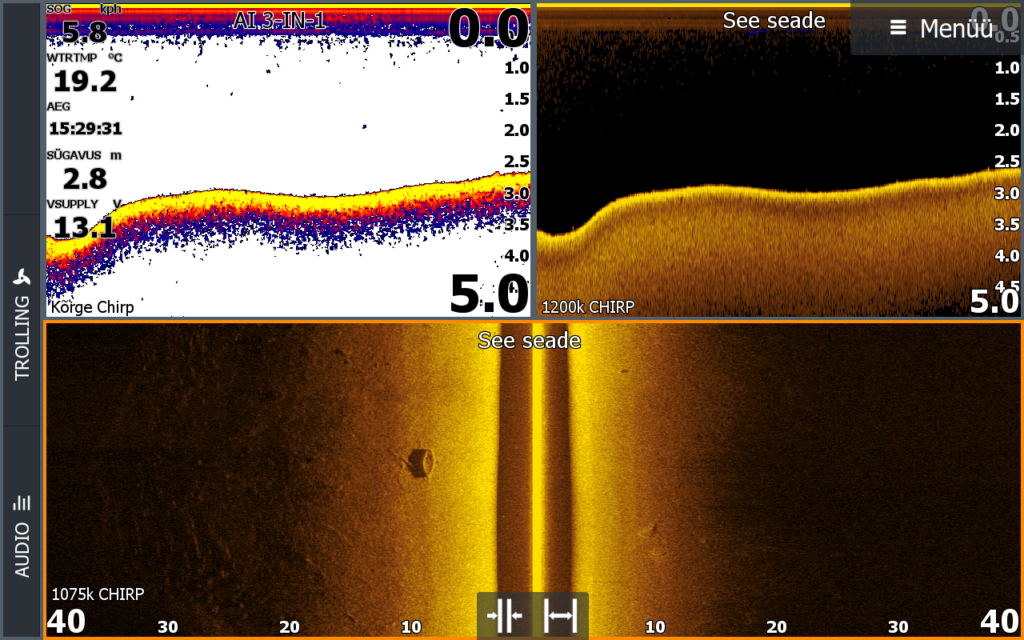
A small sunken sailboat 10 m to the left of the boat, depth under the boat 2.8 m.