




Text written by: Alexander Andrusenko
Lowrance Eagle Eye 9 LIVE – budget-friendly LIVE sonar
LIVE sonar is currently a very hot topic in the fishing world. As is well known, a LIVE sonar is a sonar that lets you see fish movement in real time, like ultrasound. There are heated debates about the use of LIVE sonars in all kinds of social media groups and forums, but I won’t start discussing that topic in this article. I’ll only say briefly that LIVE sonars are here to stay. They don’t catch fish for you on their own – in some conditions they are useful, in others they offer no advantage compared to old-school fishing. If the fish isn’t biting, you can watch it on any size screen and it still won’t make it bite. But there are situations where, without a LIVE transducer, it is practically impossible to catch fish any other way, and there it provides a major advantage because you can see where to cast. Everyone can decide for themselves whether it is for them or not.
For those who do decide they want to try it, to dive into the LIVE world you need to buy a LIVE transducer with a module (the so-called “Black Box”), a suitable display that supports this technology, and also a rotating mount (“rotator”) to direct the transducer. Average setups without a rotator easily cost over €3000, even with a 9-inch screen. If you want a larger screen, it costs even more. And if you want to use the same display with a regular sonar too (2D Sonar and Downscan), you still have to spend several hundred euros on a separate transducer. For winter use, you may also need a separate ice transducer. All in all, it adds up to a pretty serious amount. On top of that, you have to consider that the transducer with module + display consume quite a lot of power and you may need a higher-capacity battery. The Black Box is a relatively large and heavy unit, and you need to think about where to mount it and how to run the cables. This is especially relevant if you want to use a LIVE transducer in winter – the whole setup becomes quite heavy and takes up space.
Last year, however, a new budget-friendly and compact LIVE sonar set hit the market – Lowrance Eagle Eye LIVE, whose price is at least 2 times lower than the regular Lowrance Elite FS + Lowrance Active Target system or any other brand’s LIVE combo. I became genuinely interested in trying it and understanding what you get for the money. This autumn I finally got the chance to test this unit. I’ll share my review of whether you can actually do anything useful with such an affordable device or whether it is just a toy. It is certainly not appropriate here to compare this budget-friendly device with top models that cost 3–4 times more; those are devices from a completely different class.
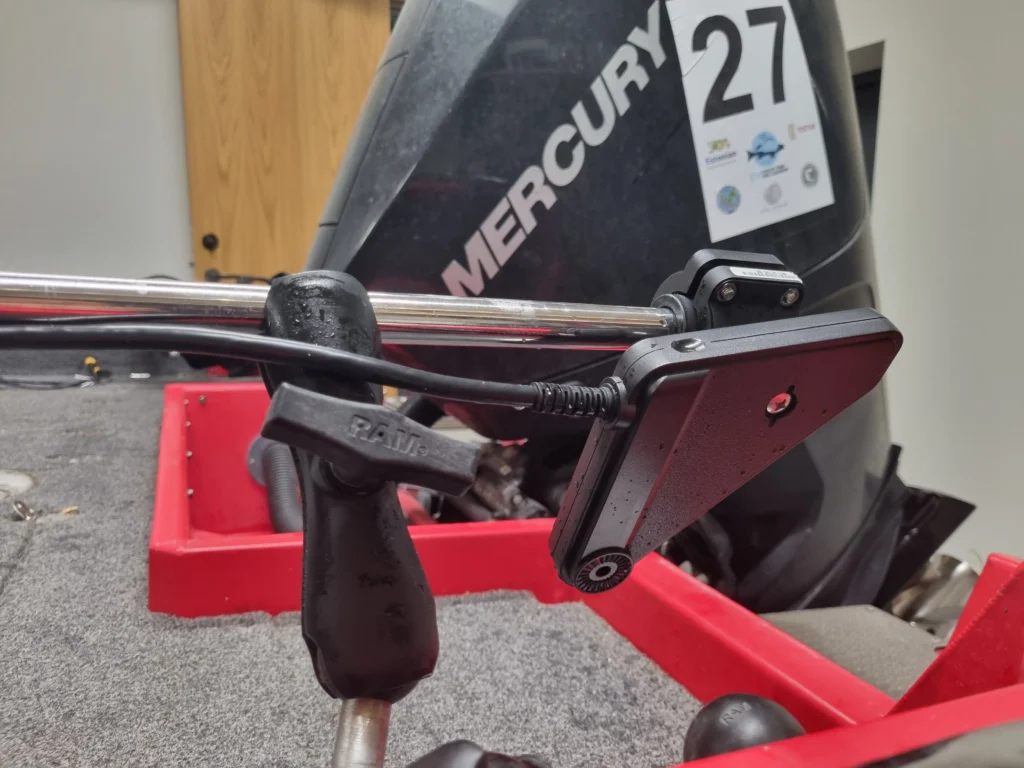
So, one day I got the Eagle Eye set and started installing it. When I picked up the box, the first question was: where is the second box? Usually the display is a separate product, and the transducer with the module is another separate item in a separate box. But the entire Eagle Eye set was in one medium-sized box, and it doesn’t even have an extra module. The display is 9 inches and much lighter than the more expensive models. The transducer itself is also very compact and connects directly to the display with one cable. The display has only 2 cable ports – power and 1 transducer.
The next question was how to connect a regular sonar to it if I wanted to try a 2D sonar image or Downscan. But it turned out that no other transducers are needed and you can’t install them anyway, because all the necessary functionality is already built into the LIVE sonar itself. The transducer itself is very compact and light. What I liked most is that the transducer is always mounted in one position and that position never needs to be changed. With other LIVE sonars, if you want to use the Down view, the sonar has to point downward. But if you want to switch to Forward view, you have to lift the transducer out of the water and change its position relative to the shaft. First, this takes a lot of time, and second, the sonar angle is so important that if you change it, it takes a lot of effort afterward to get that perfect angle back. Usually nobody changes the transducer angle, and then you end up using only one view. The Eagle Eye transducer, however, is always in one position and can be mounted completely rigidly, and you never have to change its position – whether you are looking at LIVE Down or Forward, or normal 2D sonar, or Forward, it makes no difference. You simply select the view you need on the screen, but you don’t have to move the sonar. Of course, the display also includes chartplotter functionality.
Now for the biggest differences compared with top models. First, the screen is not touchscreen. With a touchscreen, browsing the map is of course more convenient, but for the LIVE image it makes no difference to me, because in most cases you set it up once and during fishing there is not much need to change settings. You choose the suitable down and forward range and contrast, and that’s basically all there is to setup, so a touchscreen is not that important for the LIVE image. There is very little setup, and it is actually very simple.
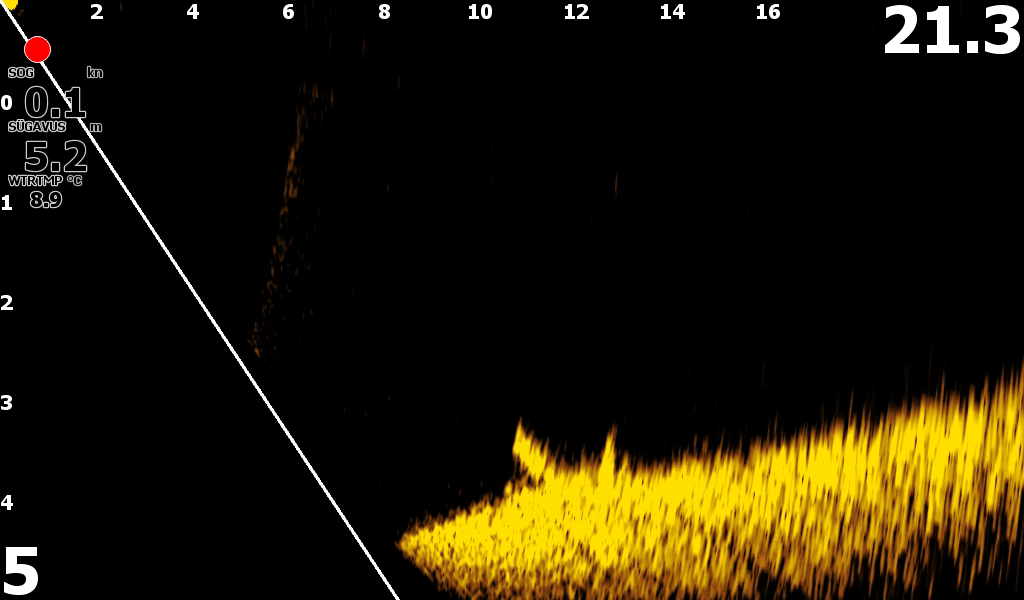
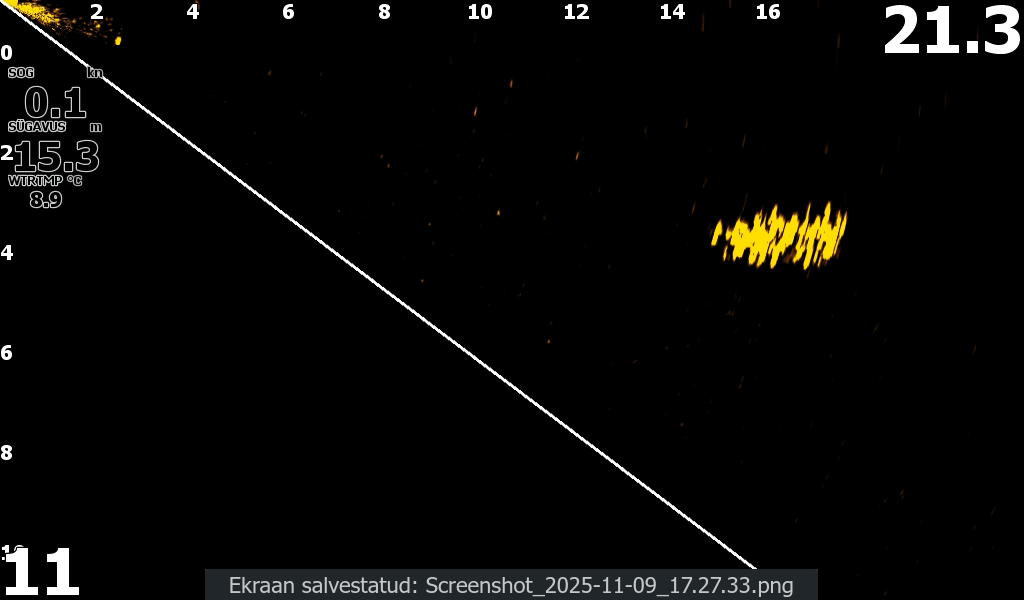
The biggest difference in the LIVE image, of course, is that part of the screen in Forward view is cut off diagonally, so to speak (see the picture), meaning that in Forward mode you cannot see directly under the boat. In “Forward” view you only see about a 100–120° sector, not the full area like on ActiveTarget (~180°). Depending on the selected down and forward range, the size of the blind area you cannot see changes. For example, if the depth is set to 10 meters and the distance range is set to 21 meters, then at a distance of 10 meters from the boat you cannot see deeper than 6 meters. The farther away from the boat, the larger the visible area becomes.
What causes this? More expensive LIVE transducers have 3 crystals – i.e. transducer elements that direct the signal in three different directions, and then the 3 partially overlapping visible areas are programmatically stitched together so that the screen shows a smooth image both under the boat and in all directions ahead. Since the Eagle Eye was created as an affordable alternative, it has only 1 crystal. So when you look Forward, the part of the area that would go “down” simply stays out of the picture. One crystal cannot simultaneously cover both down and forward angles (as ActiveTarget does). This cannot be fixed with settings, because it is an optical and geometric limitation of the transducer, and you have to keep that in mind.
I tested the Eagle Eye unit in a fairly deep body of water and used it to fish for pelagic pike (i.e. pike swimming in midwater). I kept the down range at 8–12 meters and the forward range mostly at 21–25 meters. As I explained earlier, fish that are deeper and too close to the boat are not visible on the screen. Pike was clearly visible when it was 4 to 8 meters below the surface and 8 to 21 meters away from the boat. I was also able to present lures to such pike, and the lure was visible on the screen as well. Fish that are too deep or too close to the boat cannot be seen. The lure was visible on the screen from over 20 meters away, and larger pike too, up to 25 meters from the boat.
Smaller pike over 20 meters from the boat or pike at a poor angle (for example, with its tail toward the boat), which can sometimes also be hard to see even with a device three times more expensive, are not always visible. Let’s say this: you won’t see every fish, but the ones I was targeting were mostly visible. The Eagle Eye’s field of view appears to be slightly narrower than ActiveTarget’s, which means you need to correct a bit more with the rotator so that the image of the lure or fish does not move out of the visible area when the fish or boat moves. Both in midwater and in shallower water near the bottom, schools of fish were very clearly visible. With medium noise suppression, the image is even cleaner than on ActiveTarget, and fish schools have very strong contrast (see the picture). At 4 m depth, the bottom line, structure, and fish are visible from 8 meters away from the boat and up to 21–25 meters.
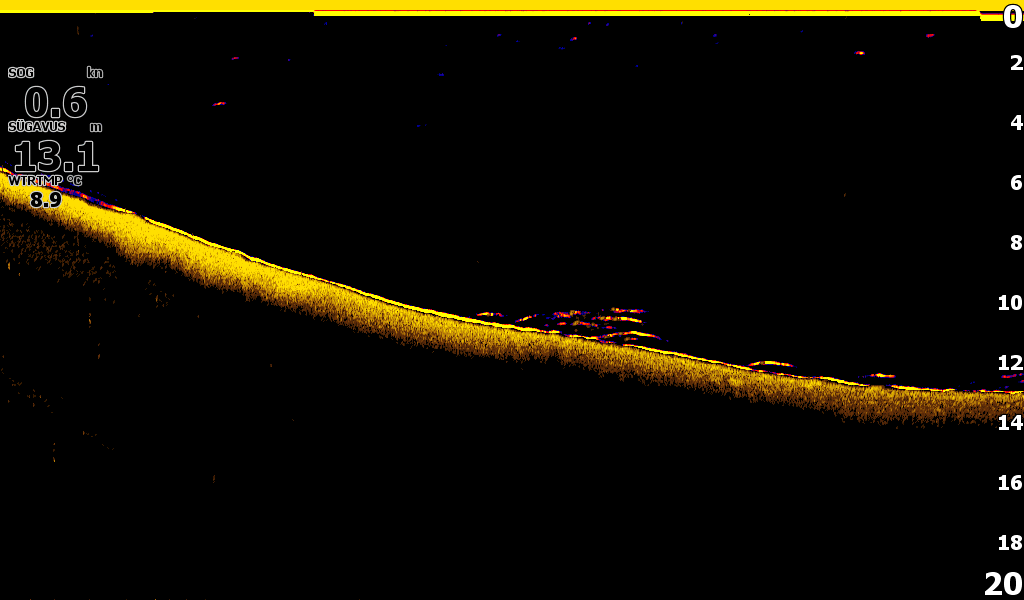
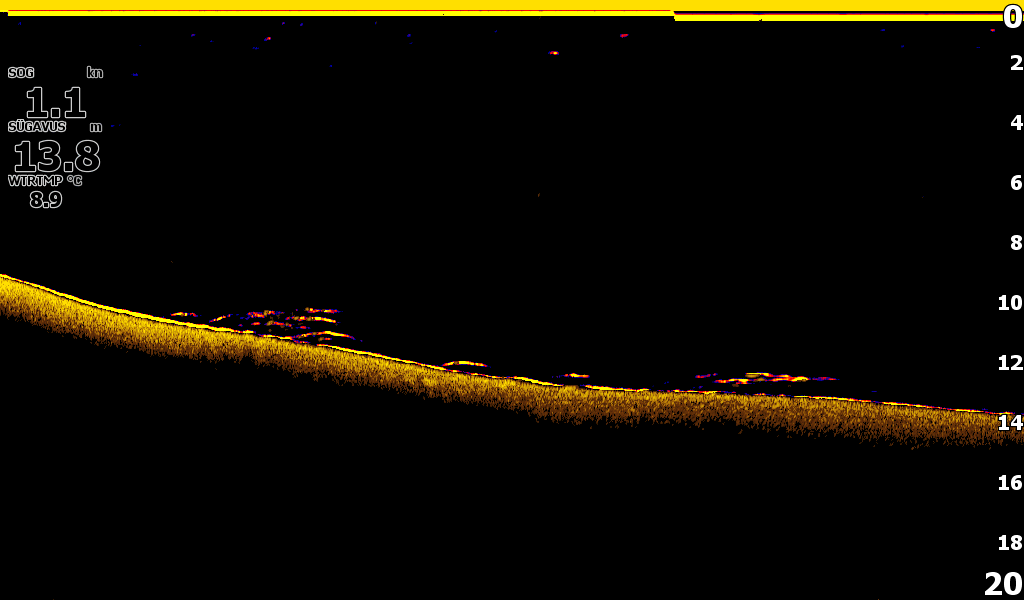
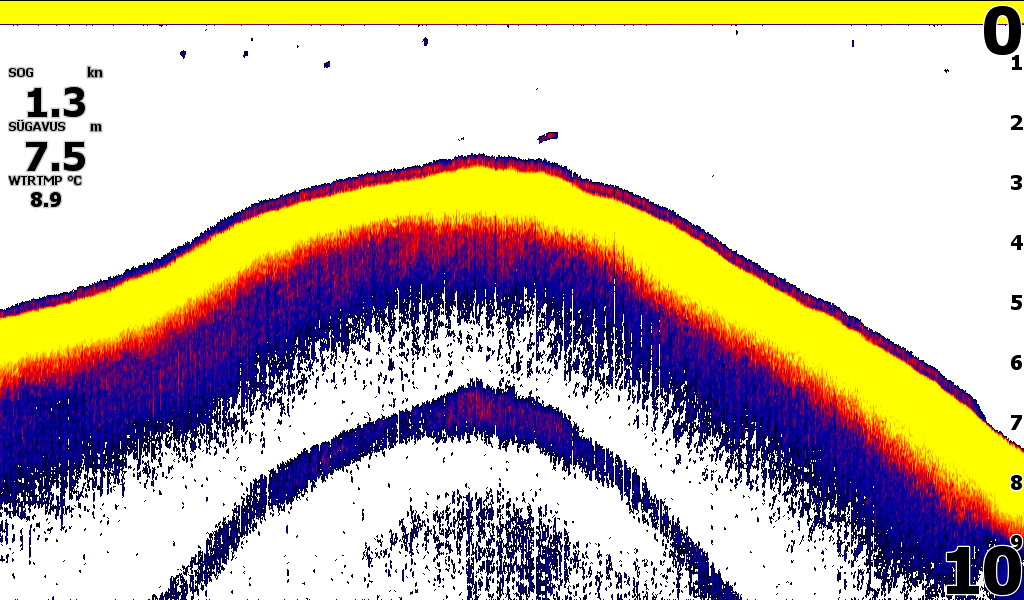
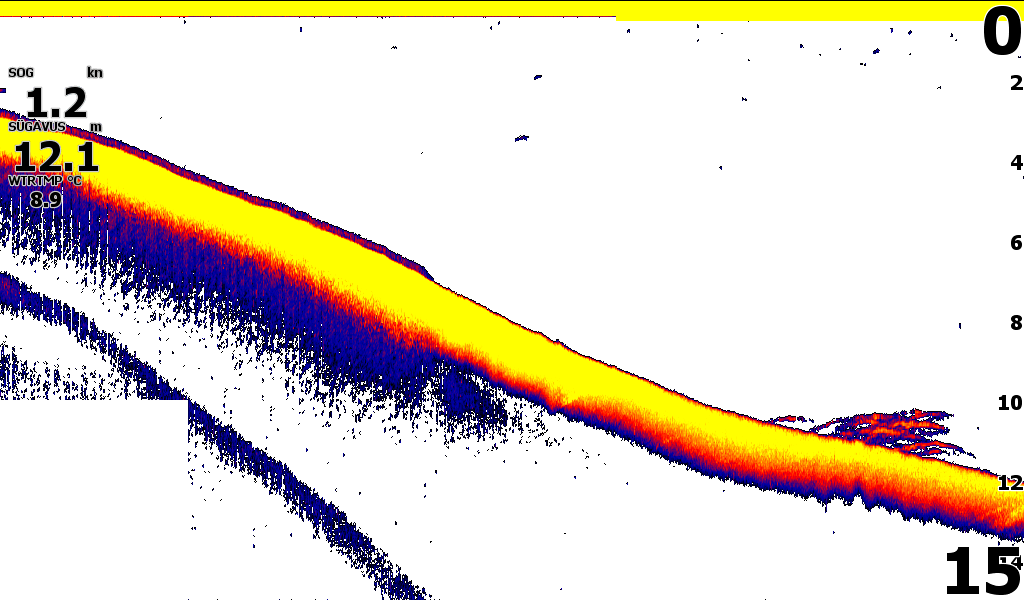
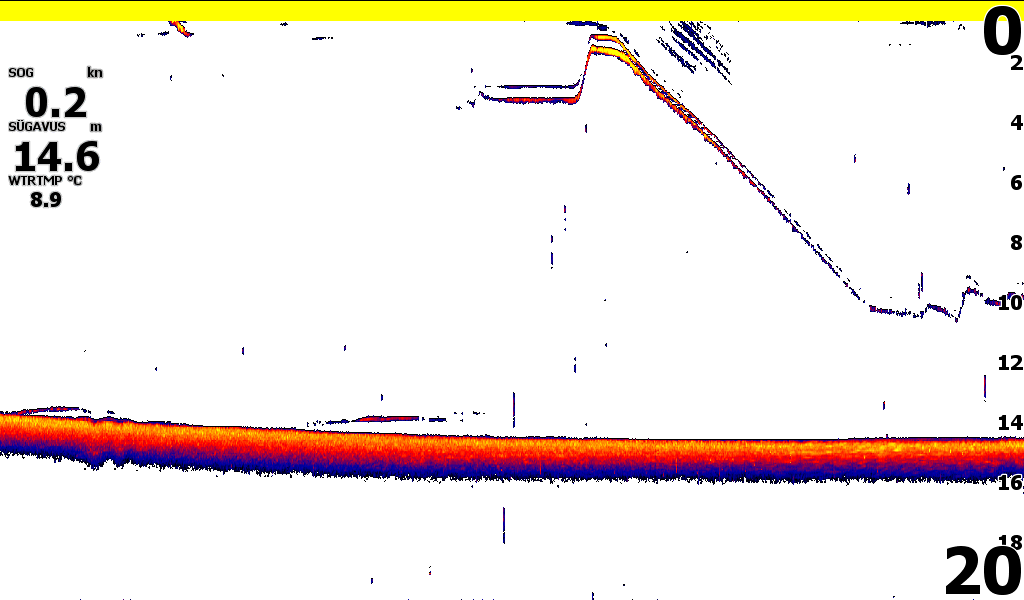
Then I also tested the 2D sonar view and Downscan. The 2D sonar is a very decent Chirp, and I didn’t notice any major differences compared with more expensive models. Bottom structure and fish are visible. On Downscan, the Fish Reveal function works properly (it draws fish with stronger contrast). Overall, I would say the regular sonar works about as well as on more expensive models. The map application also works the same, except that it is not touchscreen.
I’ll try to make a summary. Eagle Eye 9 Live is a much more affordable alternative to top models, and of course you have to keep in mind that a device that is 3–4 times cheaper cannot be as good as the top models. Yes, you won’t see absolutely every fish you would see with ActiveTarget. Yes, its field of view and detail are not quite the same. Yes, it is not touchscreen. But on the other hand, it is much more affordable, and price sometimes settles things. It is definitely harder to do precision fishing with this device, where you present the lure directly in front of fish in every position and in all water layers with centimeter-level accuracy, but under certain conditions it is possible to fish with it and catch fish. I personally caught 4 pike on the test day, and I have to mention that the pike are already in winter mode and completely passive, practically ignoring lures.
I think the most suitable fishing conditions for the Eagle Eye device are shallower bodies of water, fishing by bottom structures or fish schools, and definitely winter fishing through the ice. I personally plan to use the Eagle Eye in winter, because it is so light and consumes very little power. With ActiveTarget there is always the big dilemma of whether I really feel like carrying all that gear with me. The Eagle Eye set would be many times lighter, and even a small 10 Ah battery would do. I would put the small lithium battery in the tackle box, screw the 9-inch display to the box, and that’s it. In Forward view I would scan around for fish, and once fish are found, switch to Down view and fish. You don’t even have to change the transducer angle for that. I haven’t measured it yet, but it seems to me that the Eagle Eye transducer would fit into a smaller ice hole than ActiveTarget. ActiveTarget requires at least a 180 mm ice auger diameter, while Eagle Eye would probably work with a smaller one.
Is this device for you? Everyone has to set their own budget and choose the suitable equipment accordingly. But the good news is that now there is also a device in a more affordable price range that lets you take your first steps in the world of LIVE fishing.